Michele Borrelli is full professor of
General Pedagogy
at the University of Calabria in Italy and has
lectured Didactics of Social Sciences, Historical
and Systematic Pedagogics and Intercultural
Pedagogics at the universities of Wuppertal,
Frankfurt, Giessen and Nuremberg.
Michele Borrelli was born in 1947 in Acquappesa,
Calabria.
At 16 years of age he moved to Germany where he
received the pedagogical formation and philosophy of
the
“Scuola
di Gießen” (Giessen
School). He studied anthropology, Roman law studies,
political science and pedagogical science at Justus
Liebig University, Giessen passing the Staatsexamen
für das Lehramt an Haupt- und Realschulen (Justus
Liebig-University, Giessen, Faculty: Didaktik der
Sozialwissenschaften) in 1972.
After the Staatsexamen, he took an MA - Master of
Arts, graduating with honours in 1974 followed by a
PhD - Doctor of Philosophy, graduating magna cum
laude in 1978 (both at Giessen University). His
Master of Arts thesis was entitled:
Lernzielermittlung,-legitimation und –operationalisierung
im Bereich Politischer Didaktik zwischen Ideologie
und Wissenschaft.
It was published in Kurt Gerhard Fischer (by),
Politische Pädagogik zwischen Pädagogik und Politik,
Metzler, in 1976. His Doctor of Philosophy thesis
was entitled:
Politische Bildung in Italien – Revolution und
Konterrevolution.
It was published by Metzler, Stuttgart in 1979.
He has coordinated theoretical and practical teacher
training courses at Giessen University, as well as
after-school pedagogical/experimental courses in
Hessen (Germany) for the “Landeszentrale für
Politische Bildung” (Hessen), Germany. He also
organised, coordinated and administered cultural
courses for Italian workers in Germany on behalf of
the Italian ACLI association for occupational
training (Stuttgart, Germany) as well as
after-school courses in Austria.
In 1988, following his term as lecturer in
Intercultural Pedagogics at Nürnberg University, he
returned to Calabria to take up the Chair of General
Pedagogy at the University of Calabria (from 1992). He continued to work on projects of scientific study
with academics in Germany (especially philosophers,
science theorists and teachers). Drawing on his
almost twenty years of study, teaching and research
in Germany, he mapped a theoretical framework to be
used as common scientific ground and the source of
scientific exchange between intellectuals from
various different scientific specialisations and
perspectives. The underlying objective of his
research was to trace the foundation of the social
sciences, of pedagogical science in particular.
One of the main areas that Michele Borrelli has
explored is the methodological approach to
ontological and dialectic enquiry in modern society
and ultimately, dialectic pedagogical ontology (Pedagogia
come ontologia dialettica della società,
[Pedagogics:
a dialectic ontology of society],
Pellegrini, Cosenza (first edition: 1998, revised
and updated edition: 1999, reprints: 2002, 2005,
2007, 2009, 2011). The aim of this book is to
develop a reconstruction about dissolution of the
historical-philosophical thought (from the
philosophy of being or Ursprungsphilosophie alla
Subjektphilosophie and Bewußtseinsphilosophie, from
the Reflexionsphilosophie to the Sprachphilosophie
and Postphilosophie) and of the
historical-scientific thought (from the classical
Positivism to Neo-Positivism of the Vienna’s School,
from the Popper’s Critical Rationalism to Critical
Theory of the Frankfurt School to Kuhn’s Post-empiricis).
Besides, this study represents a critical lecture of
the dissolution quoted above. This reconstruction
underlines that the paradigm (anti-metaphysics) that
come with every metaphysical dissolution never
cancels the metaphysician but reconstitutes it by a
different position. The philosophical-scientific
passages that are reconstructed (from the
Ursprungsphilosophie to Subjektphilosophie/Reflexionsphilosophie
and to Sprachphilosophie) confirm that every
philosophical turn (Wende) comes true inside the
transcendental and never outside of it. Every
(metaphysical) dissolution does not come out totally
never from its genesis that is from the
(transcendental) possibility of its own
(transcendental) condition. To go beyond the
metaphysician means also to go back in the
metaphysician as only possibility of criticism of
the metaphysical. It is possible to go beyond the
criticism only inside the criticism borders. To come
out of the dialectic always means to go back in the
borders worn by the dialectic. The pedagogical
reflection follows the philosophical-scientific
process of the general dissolution of the every
transcendental element. It is developed inside the
dissolution process until the borders of the
dialectics of the conceptual paradoxicality and of
its self-laceration. The result of this theoretical
process is merciless and paradoxical: pedagogy means
philosophical reflection about thought self-paradoxicality.
Consequentially, pedagogy means reflection about its
own paradoxicality: it is a philosophical protest
against itself and the thought; it also is an
attempt to bring whit the concept beyond the concept
(Adorno).
His research into the foundation of the social
sciences, which commenced with the series entitled,
Metodologia delle Scienze Sociali
[Methodology
of the Social Sciences],
a work reflecting the systems theory of Niklas
Luhmann and the pragmatic transcendentalism of
Karl-Otto Apel and in association with other leading
German-speaking exponents of contemporary
philosophy, also touched on contemporary Italian
philosophy, and again involved some of its leading
figures.
One of his key mentors was Kurt Gerhard Fischer,
professor of the theory of political education at
Giessen University and extremely learned and erudite
social sciences scholar as well as expert of
political teaching.
He is the author of over 200 publications, largely
in German and Italian language, but also in French,
English, Dutch, Turkish and Greek.
His philosophical theories regarding the foundation
of intercultural pedagogics have been published in
Italian, German, English, French, Dutch, Turkish and
Greek; furthermore, they have been the object of
much in-depth discussion in foreign books and
journals.
Its privileged area of research
is the critical pedagogy. Among his works in this
area: M. Borrelli, 2004, «L’utopizzazione della
critica.
La pedagogia nel rapporto di tensione tra l’utopicità
del concetto e la fattualità della contingenza», in
M. Borrelli (a cura di/ed.), Pedagogia critica,
Pellegrini, Cosenza 2004, pp. 211-232; anche in
versione tedesca/also in german version: «Utopisierung
von Kritik. Pädagogik im Spannungsverhältnis von
utopischem Begriff und kontingenter Faktizität», in
D. Benner, M. Borrelli, F. Heyting e C. Winch (hrsg./ed.), Kritik in der Pädagogik. Versuche über das Kritische in Erziehung und
Erziehungswissenschaft,
‘Zeitschrift für Pädagogik’, n.46, Weinheim: Beltz
2003, pp. 142-154; e in versione inglese/ also
available in english: «The Utopianisation of
Critique: the Tension between Education Conceived as
a Utopian Concept and as one Grounded in Empirical
Reality», in F. Heyting, C. Winch (edited by),
Conformism and Critique in Liberal Society,
‘Journal of Philosophy of Education’, Vol. 38, Issue
3, Oxford: Blackwell Publishing Incorporated. 2005,
pp. 441-454 (European research project
Kritik in der Pädagogik,
published in German, English and Italian).
In addition, he has translated, edited and presented
to Italian audiences the most recent essays of the
German philosopher Karl-Otto Apel, collating them in
three volumes in accordance with the philosopher's
wishes: Karl-Otto Apel,
Lezioni di Aachen e altri scritti
[Aachen
lessons and other papers],
Pellegrini, Cosenza 2004; Karl-Otto Apel,
Cambiamento di paradigma.
La
ricostruzione trascendentalermeneutica della
filosofia moderna
[A
change of paradigm. The transcendental and
hermeneutic reconstruction of modern philosophy],
Pellegrini, Cosenza 2005 and Karl-Otto Apel,
Ermeneutica e filosofia trascendentale in
Wittgenstein, Heidegger, Gadamer, Apel
[Transcendental
hermeneutics and philosophy in Wittgenstein,
Heidegger, Gadamer, Apel],
Pellegrini, Cosenza 2006.
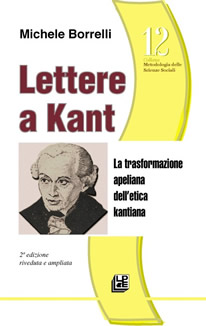
He wrote a volume on Kant (Lettere
a Kant. La trasformazione apeliana dell’etica
kantiana)
[Letters
to Kant. Apel's transformation of Kantian ethics],
Pellegrini, Cosenza 2005).
Michele Borrelli wrote six letters in order that
aporias and conflicts of the Kantian Reason can be
overcome and also to think about ethics foundation
or about philosophy and science and/or about social
sciences. The six letters in the book are addressed
to Kant as alternative remarks: according to
transcendental pragmatic point of view and Karl-Otto
Apel’s double passage, the argumentation is
developed through the passage from knowing I to the
co-subject or inter-subject and from the
separation-distinction between practical reason,
theoretical reason and esthetical reason to
unification of these three meanings of reason in the
meaning of the argumentative reason. Through a deep
analysis that considers lot domains of philosophy
and social theory (phenomenology, hermeneutic, logic
of the social science, theory of knowledge, the “end
of philosophy” theory and its revival through post
metaphysic key), Lettere a Kant focuses on
the problems that menace the humanity. Besides,
Lettere a Kant provides practical and
theoretical solutions to these problems through
Karl-Otto Apel’s ethics of the speech. This one,
unlike Kant’s ethics, represents a clear, illuminant
and upriver answer.
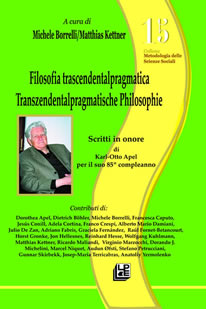
He also edited, with M. Kettner, the volumes: Laudatio
in honorem Karl-Otto Apel per il suo 85esimo
compleanno,
Pellegrini, Cosenza 2007; Filosofia
trascendentalpragmatica - Transzendentalpragmatische
Philosophie - Scritti in onore di Karl-Otto Apel per
il suo 85esimo compleanno, Pellegrini, Cosenza,
2007.
Among his recent publications:
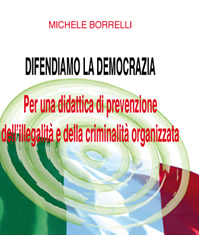
Difendiamo la democrazia. Per
una didattica di prevenzione dell’illegalità e della
criminalità organizzata, [Defend
democracy. For
a didactic prevention of illegality and organized
crime],
Pellegrini, Cosenza 2009;
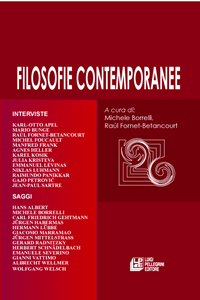
Filosofie Contemporanee,
[Contemporary
Philosophies],
volume edited with Raúl Fornet-Betancourt, which has translated texts by French and
German,
Pellegrini, Cosenza 2010; the monographs:
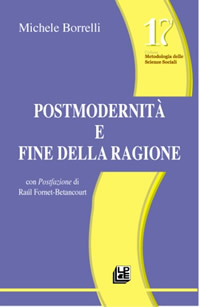
Postmodernità e
fine della ragione,
[Postmodernity and the end of
reason],
with
an afterword by
Raúl
Fornet-Betancourt, Pellegrini, Cosenza 2010;
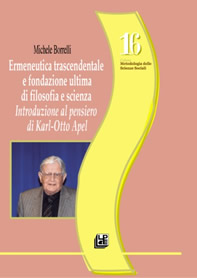
Ermeneutica trascendentale
e fondazione ultima di filosofia e scienza.
Introduzione al pensiero di Karl-Otto Apel,
[Hermeneutics
transcendental and ultimate foundation of philosophy
and science. Introduction to the Thought of
Karl-Otto Apel],
Pellegrini, Cosenza 2008; Lettere a Kant – La
trasformazione apeliana dell’etica kantiana,
Pellegrini, Cosenza 3a ed. 2010.
He translated from German into Italian the work:
Worum geht es in
der Philosophie? Grundfragen der Philosophie
zwischen Wahrheit und Macht
(LIT
Verlag GmbH
& Co. KG
Wien, Zweigniederlassung Zürich 2008,
LIT Verlag Dr. W.Hopf Berlin 2008),
of the philosopher Reinhard Hesse,
published in the Collana Methodology of Social Sciences,
18, Cosenza: Pellegrini, 2010.
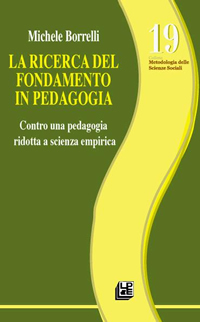
Among the recent works, the monograph:
La
ricerca del fondamento in pedagogia - Contro una
pedagogia ridotta a scienza empirica,
Pellegrini Editore, Cosenza 2011.
The essays collected in this volume demonstrate that
research foundation in the fields of 'science' of
the humanities have to deal with two problems:
firstly with the problem of the dominance of the
logic of empirical sciences (explanatory sciences)
over the logic of 'science' of comprehending; on the
other hand it must be noticed that this logic of the
explanatory sciences results in the loss of identity
of 'science 'of comprehension. Referring to this
problem, the research of foundation assumes an
extended survey not only in the area of
philosophical hermeneutic, but also of semiotics and
extramethodic fields (Gadamer), which open the
symbolic sphere and the possible agreement on norms
and values. Taking the necessity of an open
discussion into consideration, the ten essays
collected in this volume follow various perspectives
of the foundation of pedagogical thought. Starting
from the methodological discussion of the
differences between explanatory science and science
of comprehension, the articles passes over to the
fields of philosophical hermeneutics (Gadamer),
critical hermeneutics and philosophy of language as
well as to pragmatic universalism (Habermas) and
transcendental philosophy (Apel). Beyond an
empirical point of view, the transcendental and
generally reflexive method appears necessary to
resume and re-discuss, among other things, the
proposal of Kant to differentiate the concept of
Reason within its unity and to remember the concept
of Being of Heidegger as the foundation of truth.
He founded and directs a series of publications
concerning theoretical and practical pedagogics as
well as the more specialist areas of social sciences
(from philosophy to the problems of language, from
sociology to the theory of knowledge and science,
and from pragmatic perspectives to hermeneutic
discourses, and so forth): “Methodology of social
sciences”; “Theoretical and practical Pedagogy”;
“Pedagogical Historiography” (Pellegrini Publisher).
He also founded and directs “Topologik -
International Journal of Philosophy, Educational and
Social Sciences”.
Topologik is a
Peer-Reviewed
Journal. The Journal contains researches
and studies regarding the ambits of Human and Social
Sciences and of Theoretical Philosophy and of
General Theory of Education.
He is also member of the Scientific Committee of «Internationaler
Wissenschaftlicher Beirat des Jahrbuch für Bildungs-
und Erziehungsphilosophie» and of the “Red” (Internacional
Ética Del Discurso-Internationales Netzwerk
Diskursethik-International Network Discourse Ethics)
founded and directed by Prof. Dr. Dorando J.
Michelini.
He cooperates with Wuppertal University (Chair of
General Pedagogy: Prof. Dr. Rita Casale) and the
University of Aachen (Chair of Philosophy: Prof. Dr.
Raúl Fornet-Betancourt).
He is member of the Editorial Board of
the Journal ‘Concordia - International Journal of
Philosophy’, founded and directed by Prof. Raúl
Fornet-Betancourt.
He is also a member of the Scientific
Committee of Journal “Cirpit
Review” (Italy).
He is also, amongst other things, President of the
“International Karl-Otto Apel Centre of Philosophy”
and “Karl-Otto Apel International Prize for
Philosophy”.